
Last reviewed: July 2026. Recruitment rules, ages, and vacancy numbers change with nearly every cycle — this article will be revisited when major rules change, but always confirm current-cycle details against the official notification linked in each section.
Most students don’t lose out on government jobs because they lack ability. They lose out because they apply for the wrong exam at the wrong stage, or find out about eligibility rules after a notification has already closed. The career map is simple in outline — 10th, 12th, graduation, specialisation — but each stage hides a real decision: whether to take a job now or keep studying, which exam actually matches your current qualification, and how many genuine attempts you have before an age cutoff ends the option.
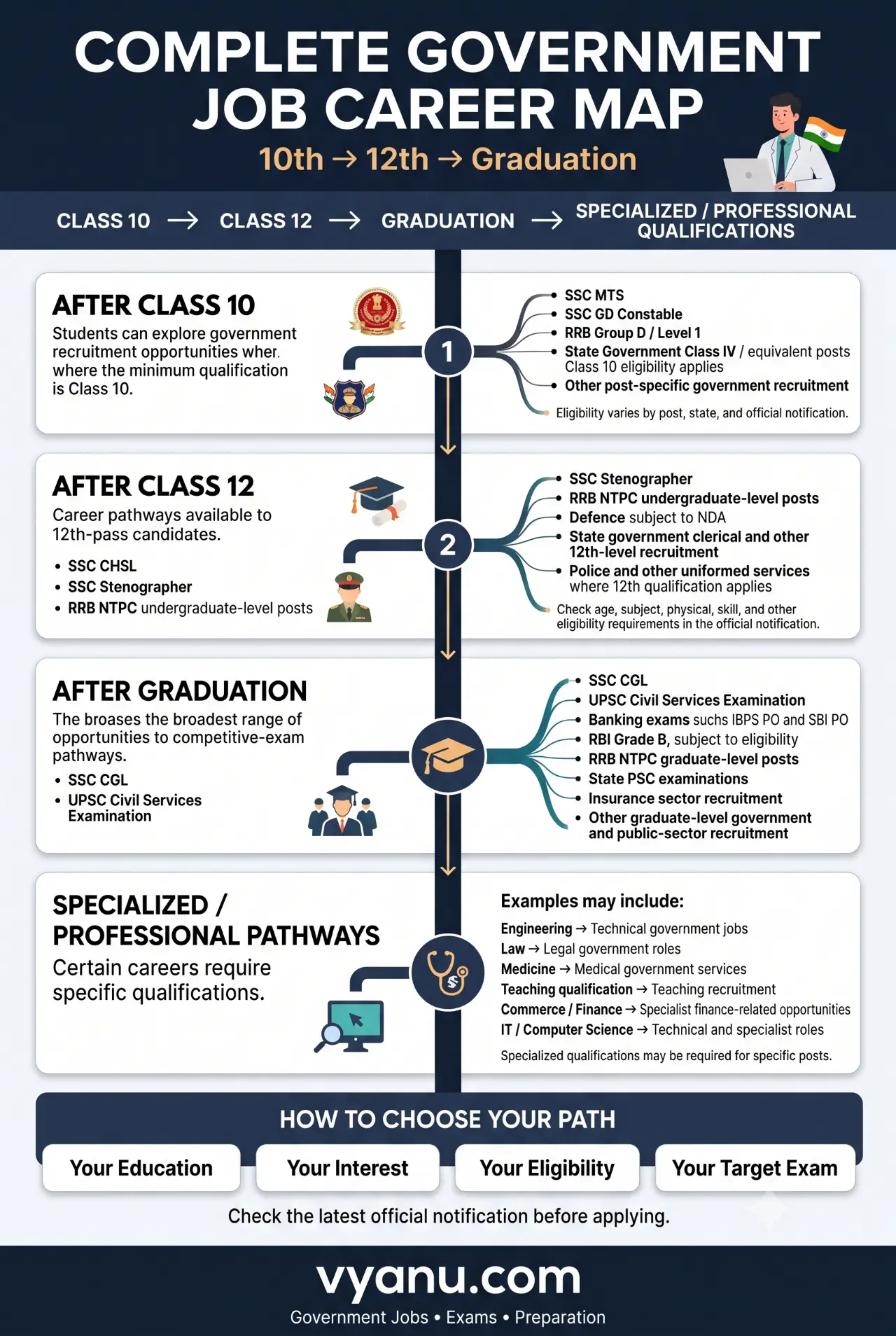
This guide uses that map as a starting frame and builds outward: sourced vacancy-and-applicant numbers from named recruitment cycles, the real decision trade-offs at each stage, and where a general answer like “18 to 25 years” hides post-wise and category-wise exceptions. Every data point below links to where it came from, and every age/qualification rule is tied to a specific cycle rather than stated as a permanent fact.
After Class 10: A Real Entry Point, Not a Waiting Room
A Class 10 pass is a genuine entry qualification for central government recruitment. SSC MTS (Multi-Tasking Staff) and Havaldar posts under CBIC and CBN are the clearest examples, and having a 12th, graduate, or postgraduate degree later doesn’t disqualify you from applying — the listed qualification is a floor, not a ceiling, unless a specific notification says otherwise.
What the low entry bar hides is the scale of competition, and here’s the specific timeline rather than a blended figure: in August 2025, SSC reported approximately 36.17 lakh applications against the then-notified 5,464 vacancies for the 2025 MTS/Havaldar cycle — a ratio of roughly 661 applicants per vacancy at that point (source: Adda247, citing SSC’s reported data, August 2025). That vacancy count was later revised upward twice as the cycle progressed — to 8,021 and then to a final 7,948 posts by late November 2025 — but the applicant figure was not re-reported after those revisions, so the exact final ratio isn’t publicly confirmed (source: Adda247, SSC MTS Vacancy 2025). For preparation purposes, treat “600+ applicants per initially notified seat” as the reported figure for this specific cycle, not a fixed rule for every year: vacancy counts for this exam have swung from around 1,773 in 2023 to over 11,000 in 2022 and 2024 (source: Shiksha.com, SSC MTS vacancy trend), so the ratio you should actually prepare against depends on the year you’re applying under.
Age bands for MTS/Havaldar posts are also split by post and category within a single notification — the revised 2025 cycle carried separate vacancy blocks for the 18–25 age group and the 18–27 age group rather than one flat age range for every post. Check the post-wise breakdown in the current notification rather than assuming one age figure covers the whole exam.
RRB Group D, which also accepts a Class 10 pass, ITI certificate, or engineering diploma/degree, follows a similar pattern of large vacancy counts and large applicant pools, plus a Physical Efficiency Test on top of the written exam for most posts. If you’re weighing this stage against staying in school, see the decision framework further down.
After Class 12: The Widest Set of Entry-Level Choices
Clearing 12th opens a broader set of recruitment cycles: SSC CHSL, SSC Stenographer, RRB NTPC’s undergraduate-level posts, defence entry through NDA, and various state-level clerical and police recruitments. Two exams with the same nominal entry qualification can carry different age bands, different skill-test requirements, and different post-wise rules within the same notification.
| Exam (recruitment cycle referenced) | Age window as notified | What else it requires beyond 12th pass |
|---|---|---|
| RRB NTPC — Undergraduate posts (2024 cycle, CEN 06/2024) | 18–33 years as on 1 Jan 2025 | 12th pass is the base qualification; some posts (e.g. Commercial cum Ticket Clerk) additionally require a minimum percentage in 12th. Vacancy count for this cycle: 3,445 posts. |
| SSC CHSL | 18–27 years (post-dependent; verify per notification) | 12th pass plus, for specific posts, a typing or data-entry skill test after the written exam. |
| SSC Stenographer — Grade C | 18–30 years | 12th pass plus a mandatory shorthand/transcription skill test at 100 words per minute. |
| SSC Stenographer — Grade D | 18–27 years | 12th pass plus the same style of skill test at 80 words per minute — a distinctly lower age ceiling and dictation speed than Grade C. |
| NDA (Defence) | Narrow window, roughly 16.5–19.5 years depending on the specific intake | 12th pass with Physics and Maths for specific wings; exact age brackets shift slightly between the two annual NDA notifications, so check the current one directly. |
Scale matters here too, with a precise distinction worth making: RRB reported roughly 1.21 crore applications for the 2024 NTPC cycle (CEN 05/2024 and CEN 06/2024 combined, covering graduate and undergraduate posts together against 11,558 total vacancies), a figure similar to the roughly 1.21 crore applications reported for the separate 2019 cycle (source: Adda247, RRB NTPC application trends). These are applications received, as reported by recruitment-tracking sources citing RRB data — not a confirmed count of unique individuals, and not the number who actually appeared for the exam or cleared each stage. Treat the applications-to-vacancy number as a sense of scale, not your personal odds: your real competition is the smaller pool of same-category, same-post candidates who appear and clear each stage, which is published in the post-result cutoff data, not the pre-exam application count.
On defence entry: NDA isn’t the only route. Graduate-level defence entries also exist, including CDS (Combined Defence Services) and the 10+2 Technical Entry Scheme (TES), each with its own separate eligibility and selection process. NDA’s early age cutoff makes 12th pass a strong window for defence careers, but missing it doesn’t close the door on a defence career — it changes which specific entry route applies.
After Graduation: The Broadest Range, Including the Top Civil Services
Graduation opens the largest set of high-value pathways at once: SSC CGL, UPSC Civil Services, banking exams like IBPS PO and SBI PO, RBI Grade B, RRB NTPC’s graduate-level posts (8,113 vacancies in the 2024 cycle), state PSC exams, and insurance-sector recruitment. A general BA/BCom/BSc degree is sufficient eligibility for most of these — SSC CGL, banking exams, and UPSC all accept any recognised bachelor’s degree as the base qualification, regardless of subject. That’s different from the specialised pathways in the next section, which require a specific professional degree rather than any graduate degree.
UPSC Civil Services has stricter rules than most graduate-level exams, and these are worth stating precisely:
- Age window: minimum 21, maximum 32 for General/EWS candidates under the standard notified cutoff, with relaxation up to 35 for OBC and 37 for SC/ST candidates. Confirm this against the current year’s UPSC notification, since it’s re-issued each cycle.
- Attempt limits: roughly 6 for General/EWS, 9 for OBC, and no cap (within the age limit) for SC/ST candidates. An attempt only counts if you actually appear in at least one paper of the Preliminary Examination.
- Final-year eligibility: candidates in their final year of graduation can apply for and appear in the Preliminary Examination. What UPSC requires by the Mains stage is documented proof that you meet the qualification — the exact form and timing of that proof is specified in that year’s notification, so check the current cycle’s exact wording rather than a general summary.
This is stricter than SSC CGL or banking exams, where age relaxation and attempt patterns are typically set post-by-post rather than as one exam-wide cap. That’s a real difference to plan around, but it isn’t a reason to treat UPSC and SSC CGL as strictly first choice versus backup — many candidates prepare for overlapping syllabi (general studies, reasoning, current affairs) across both at once, and the right structure depends on how much preparation time you have each week.
Specialised and Professional Pathways
Some government roles sit outside the general SSC/UPSC/banking track because the job itself legally requires a specific professional qualification, not just a graduation certificate. SSC CGL and banking exams accept any bachelor’s degree; the roles below need a named degree or licence, and the exact requirement varies by the specific recruitment notification — the summaries below are a starting point, not the final eligibility text.
- Engineering → recruitment such as SSC JE (Junior Engineer), state engineering services, and PSU technical recruitment, which require a specific engineering degree or diploma in the relevant discipline — a general BSc typically won’t qualify.
- Law → judicial services exams and legal-officer posts, which require an LLB. Eligibility beyond the degree — such as years of practice or age combined with experience — varies by state and by the specific High Court’s recruitment rules, so don’t assume a fixed practice-experience requirement applies everywhere.
- Medicine → government hospital and health-service recruitment, which requires an MBBS (or relevant qualification) and registration with the applicable medical regulatory authority, such as the National Medical Commission, as required by that specific recruitment.
- Teaching → recruitment into government school and college posts, which generally requires a B.Ed and, depending on the teaching level and specific recruitment rules, a qualifying score in TET or CTET on top of a subject degree. Requirements differ meaningfully between primary, secondary, and higher-education teaching posts, so check the level-specific rule rather than assuming one qualification covers all teaching posts.
- Commerce/Finance → specialist streams such as RBI Grade B’s DEPR/DSIM tracks, which carry specific postgraduate qualification requirements set out fresh in each year’s RBI notification — check that year’s exact wording rather than a general summary, since these are narrower and more specific than the general RBI Grade B eligibility.
- IT/Computer Science → specialist officer (IT) posts in banks and PSUs, where the exact qualification (B.Tech/B.E., MCA, or an equivalent) varies by the individual recruitment notification rather than following one fixed rule across all recruiters.
If your career goal sits in one of these fields, check the exact degree named in a recent notification for that specific post before you commit years to a general degree assuming it will be “close enough.”
Job Now or Study Further? A Framework for the Actual Decision
The career map shows four stages, but the real question most readers have is “should I take the job available now, or keep studying for a better one later?” There’s no single right answer, but there is a consistent set of trade-offs to weigh at each decision point.
Take a 10th-pass job now, or continue to 12th and beyond?
A 10th-pass government post gives you income, job security, and central government service benefits immediately — often years before a classmate finishes graduation and clears a graduate-level exam. What it typically limits is your promotion ceiling relative to posts requiring a degree, though the exact ceiling depends on the specific post’s service rules, departmental promotion exams, and in-service qualification-upgrade options, which vary by department and change with pay commission revisions — check the current pay level and promotion rules for the exact post you’re considering rather than assuming a fixed lifetime ceiling. If your household needs income now, or you’re not confident about clearing a 12th-pass or graduate-level exam within a reasonable number of attempts, taking the 10th-pass entry is a legitimate choice, not a fallback.
Take a 12th-pass job now, or continue to graduation?
This decision is different because many 12th-pass government posts don’t automatically force a choice between working and completing a degree — distance or correspondence degree programs from recognised universities are commonly used by working government employees for exactly this reason. Whether that’s realistic for a specific post depends on that post’s training period, duty hours, and attendance requirements, which vary considerably; a post with intensive initial training or field postings may leave little room for concurrent study, while a desk-based post usually leaves more. Check the specific post’s service conditions, and confirm that any distance-learning degree you pursue is from an institution and program actually recognised for the recruitment you’re eventually targeting. The clearer exception is defence entry through NDA, where the age window closes early enough that it genuinely is now-or-later, not now-and-later.
Take a graduate-level job now, or aim for UPSC/specialised entry?
Because UPSC caps your total attempts (roughly 6 for General/EWS, 9 for OBC), treat that preparation as a time-boxed project with a defined number of tries you’re willing to spend, not an open-ended pursuit. Many candidates work a graduate-level government job (via SSC CGL, banking, or a state PSC post) while preparing for UPSC in parallel, since these exams don’t share UPSC’s attempt cap and provide income during preparation. If a specific technical/professional field (engineering, law, medicine, teaching) is the actual goal, that qualification requirement is fixed by law or professional council rules, so the real decision is sequencing your professional degree correctly rather than choosing between options.
Practical Considerations Before You Apply
A low qualification bar doesn’t mean low competition — but a high applicant count doesn’t mean low odds for you either. The SSC MTS 2025 numbers above show why a 10th-pass exam can still be intensely competitive in raw terms. What that count doesn’t tell you is your category-specific cutoff, how many applicants actually appeared for the exam, or how many cleared each stage — those numbers are what matter for your actual chances, and they’re published post-result in the official cutoff and result PDFs, not in the pre-exam applicant count.
Age relaxation figures are set per recruiter and per exam, not by one central rule. A relaxation quoted for one SSC exam won’t necessarily carry over to an RRB or state PSC exam. Check the relaxation table inside that specific notification every time, even for an exam you’ve applied to before, since relaxation rules can be revised between cycles.
For government recruitment specifically, apply only through that recruiting body’s own official portal. Government recruitment is a common target for fake job postings and fee-collection scams, especially around high-applicant exams like SSC MTS and RRB NTPC. As a rule for this category of recruitment: genuine SSC, UPSC, RRB, and bank recruitment happens only on that body’s own official domain, never through a third-party link, WhatsApp forward, or an agent promising guaranteed selection; and none of these recruiters charge a fee for an interview call, offer letter, or “processing” step after your application is already submitted. If you’re ever unsure whether a specific communication is genuine, verify it by checking the recruiting body’s official website or helpline directly, rather than replying to the message itself.
Eligibility rules, age limits, and vacancy numbers change with almost every recruitment cycle. Every figure in this article is tied to a specific, named recruitment cycle and linked to its source so you can judge how current it is — but treat all of it as a starting reference, not the final word, and confirm current-cycle details against the official notification before you apply.
How This Article Was Verified
The vacancy, applicant, and age figures in this article were checked against SSC’s and RRB’s own reported data as carried by recruitment-tracking sources (Adda247, Shiksha, Testbook), with each figure linked to its specific source and recruitment cycle above, rather than presented as a general or permanent rule. Where a claim couldn’t be pinned to a specific, current, verifiable source — such as exact pay-scale figures or a universal age relaxation table — it was left out or explicitly qualified as varying by post and notification rather than stated as fact. Live links referenced in this article (including the RRB portal above) were checked at the time of writing; because recruitment portals and notifications change frequently, readers should still confirm current details against the official source before applying, and VYANU revisits this page when major recruitment rules change.
Where to Check the Official Notification
Before you apply anywhere, confirm the current cycle’s exact dates, age cutoffs, and vacancy count directly at the source:
- SSC exams (MTS, CHSL, CGL, Stenographer) — ssc.gov.in, under the “Notice Board” or “What’s New” section for the current cycle
- UPSC Civil Services — upsc.gov.in, under “Examinations” → the current year’s Civil Services Examination notification
- RRB exams (NTPC, Group D, and others) — rrb.indianrailways.gov.in, the new unified RRB portal that has replaced the 21 separate regional RRB sites as of 2026 (each regional site — including RRB Chennai, RRB Ahmedabad, and RRB Bhubaneswar — now redirects candidates here and confirms this as the official replacement). The older rrbapply.gov.in application portal is being folded into this same transition, so use the unified portal above as the current reference point.
- Banking exams (IBPS PO, SBI PO) — ibps.in for common recruitment process exams, and sbi.co.in/careers for SBI-specific recruitment
- RBI Grade B — rbi.org.in, under “Opportunities@RBI”
Frequently Asked Questions
Is it better to take a government job after 10th or continue to 12th first?
There’s no universal answer — it depends on your household’s income needs and your confidence in clearing a 12th-pass or graduate-level exam later. A 10th-pass post gives you income and security sooner, and generally comes with a lower long-term pay ceiling than posts requiring a higher qualification, though the exact ceiling depends on that post’s specific service and promotion rules. Neither option closes the other permanently, since many 10th-pass employees continue studying via a recognised distance-education program while working, subject to their post’s training and duty conditions.
Can I apply for a 10th-pass government post if I already have a graduate degree?
Generally yes. Minimum qualifications listed in a notification are a floor, not a cap, unless the notification specifically states an upper qualification limit for that post. Always check the specific notification’s eligibility section rather than assuming.
Can I prepare for a government exam while still in college?
Yes, and for UPSC Prelims specifically, you can legally apply and appear during your final year of graduation, provided you can furnish proof of your qualification by the stage that year’s notification specifies. For SSC and banking exams, most require the qualification to be complete by the application or exam date, so check the specific cutoff date in that year’s notification.
Which government exams have no limit on the number of attempts?
SSC exams (MTS, CGL, CHSL, Stenographer) and RRB exams generally have no fixed cap on attempts, as long as you’re within the exam’s upper age limit. Many major banking recruitment exams also don’t impose a separate attempt cap, but this can vary by specific recruitment and category, so always check that year’s notification. UPSC Civil Services is the major, clearly defined exception, with a capped number of attempts that varies by category regardless of age, within the overall age limit.
Which government posts require a physical test in addition to the written exam?
RRB Group D, SSC GD Constable, SSC MTS Havaldar posts, and most state police constable recruitment include a Physical Efficiency Test and/or Physical Standard Test after the written stage — but the exact structure and standards vary by recruiter. NDA and other defence entries apply their own physical and medical fitness standards through the Services Selection Board process, which isn’t the same written-exam-then-PET/PST sequence used by SSC and RRB. Clerical, banking, and most non-uniformed SSC posts don’t include a physical test.
Can I prepare for SSC and banking exams at the same time?
Yes — SSC CGL/CHSL and banking exams like IBPS PO share a meaningful overlap in reasoning, quantitative aptitude, and general awareness sections, which is why many candidates prepare for both in the same cycle. The main addition to plan for is banking-specific sections like English descriptive writing or financial-awareness topics, which need dedicated preparation on top of the shared syllabus.
Does applying for UPSC Prelims and not appearing count as an attempt?
No. An attempt is counted only if you appear for at least one paper of the Preliminary Examination, per UPSC’s own rule. Submitting an application but not sitting for the exam does not use up one of your limited attempts.
Is a general degree (BA/BCom/BSc) enough for specialised government jobs like engineering or medical posts?
No. Specialised recruitment in engineering, law, medicine, and teaching requires the specific professional qualification named in that recruitment’s notification. This is different from general graduate-level exams like SSC CGL or banking exams, which accept any bachelor’s degree regardless of subject.
Leave a comment